
Ambrose Akinmusire treats jazz less as a fixed tradition than as a living, unstable architecture – something to be built and dismantled in the same breath. His trumpet work balances abstraction with startling intimacy, and his compositions carry an emotional gravity rare in contemporary music. Across a series of landmark recordings, he has become one of the most searching voices in modern jazz. This piece traces his artistic evolution, sonic language, and the broader significance of what he continues to build.
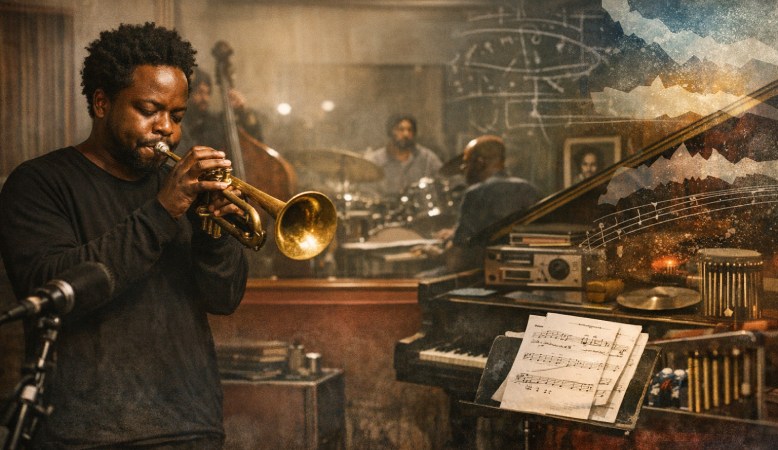
From Virtuosic Trumpeter to Restless Architect
Austin born / Oakland‐bred trumpeter Ambrose Akinmusire came out of the gate with his technical chops fully formed. A distinguished education at the Manhattan School of Music and the Thelonious Monk Institute barely registered a blip in every critic searching for that one superlative to describe him. In 2007 he was crowned the Thelonious Monk International Jazz Trumpet Competition winner, announcing him to the world with his extraordinary control and precision.
Later on, mastery wasn’t eschewed but, as it grew, Akinmusire began to shape it more towards a given track and a chosen direction. His debut recording for Blue Note in 2011, When the Heart Emerges Glistening, draws on some of the modal reticence of the late-period Davis without ever reproducing it. Here were silences as important as notes. For on the tender spot of every calloused moment (2014), poetry, song, and the addition of chamber textures fit in well, while working on the entire recorded format as if it were the environment for composition and not mere staging.
His work quietly claims ancestry from AACM and the black experimental tradition. It is foremost reluctant towards avant-garde skepticism concerning resolution. The manner in which composition and improvisation split no longer bothers him. The assemblies are meticulously planned, not culled.
Sound as Tension, Space, and Ensemble Interplay
Akinmusire’s trumpet tone resists easy categorization. It carries a raw, almost vocal quality – breathy at the edges, capable of sudden hardness – and his phrasing habitually breaks mid-thought, leaving gaps that function less as rests and more as active silence. That silence is structural, not decorative.
On When the Heart Emerges Glistening (2011), the ensemble interplay between Akinmusire, pianist Sam Harris, and bassist Harish Raghavan establishes this porous quality early. Written passages dissolve into collective improvisation without announcing the shift. The listener rarely catches the seam.
That project has now been followed by on the tender spot of every calloused moment (2020), which introduces strings and spoken word and therefore even greater harmonic tension that remains unresolved; and this can be seen as a reflection of Akinmusire’s inclination towards preserving emotional uncertainty rather than achieving catharsis. While it is clear that the strings carry a certain gravitas, they also seem to break the rhythm of the music in deliberate ways.
He seems to look at the structure as just a convenient suggestion instead of being a form of compulsion.
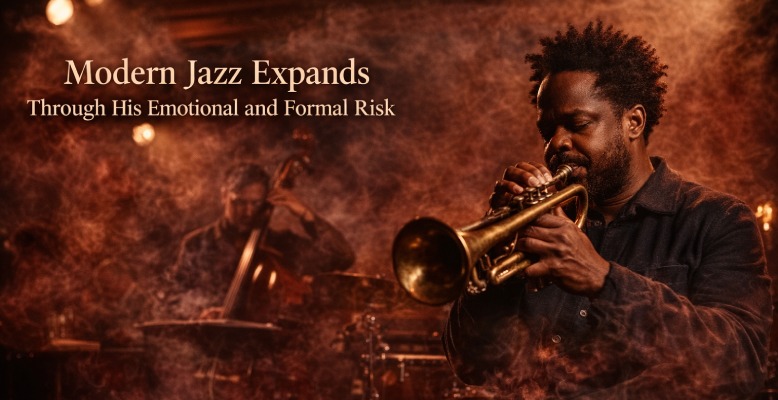
Modern Jazz Expands Through His Emotional and Formal Risk
In jazz, grief has rarely been articulated with more precision than the way it is with Akinmusire. With Glistening, Akinmusire addressed with tenderness the deaths of Black boys, shying away from a simple form of catharsis. Comforting his music did not do. It was in the wound where the story lingered, just the way it had to be.
This subject continues with his mixed-media formats, getting at the issues involved. Collaboration with poet Amiri Baraka and his persistent synthesizing of string geography and spoken poetry really reinforce the boundaries of jazz. Lines of racial memory, existential anxiety, and tenderness coexist one another in his ensembles without canceling any one out.
Certainly, he has some technical mastery; he is a top-level trumpeter. Yet more important is the phrasing, not just for the speed or range of these phrases but for their greatness to carry some emotional weight. The value of silence is another one next to sound. Abstraction is more recognition than death to sentiment.
What provides the real uniqueness in his position in modern jazz? It is his courage to let questions hang. His music does not see embracing uncertainty as a flawed gesture; instead, it makes jazz more expansive and more human, seems more fleshly and inquisitive rather than polished and conclusive, closer to lived experience than performancenaire.